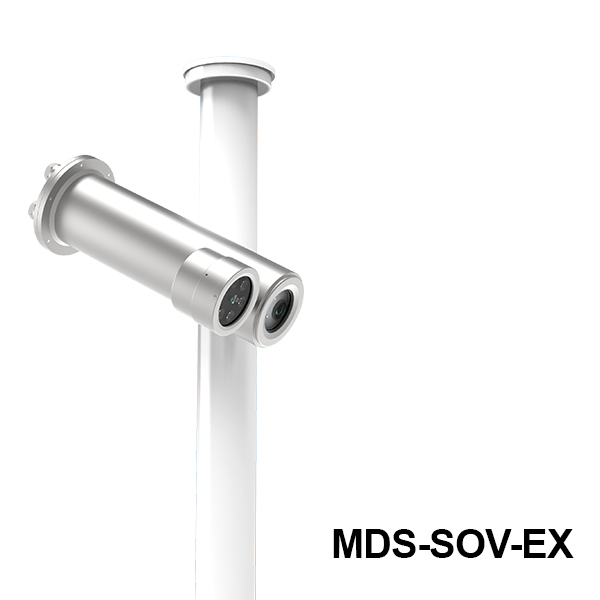
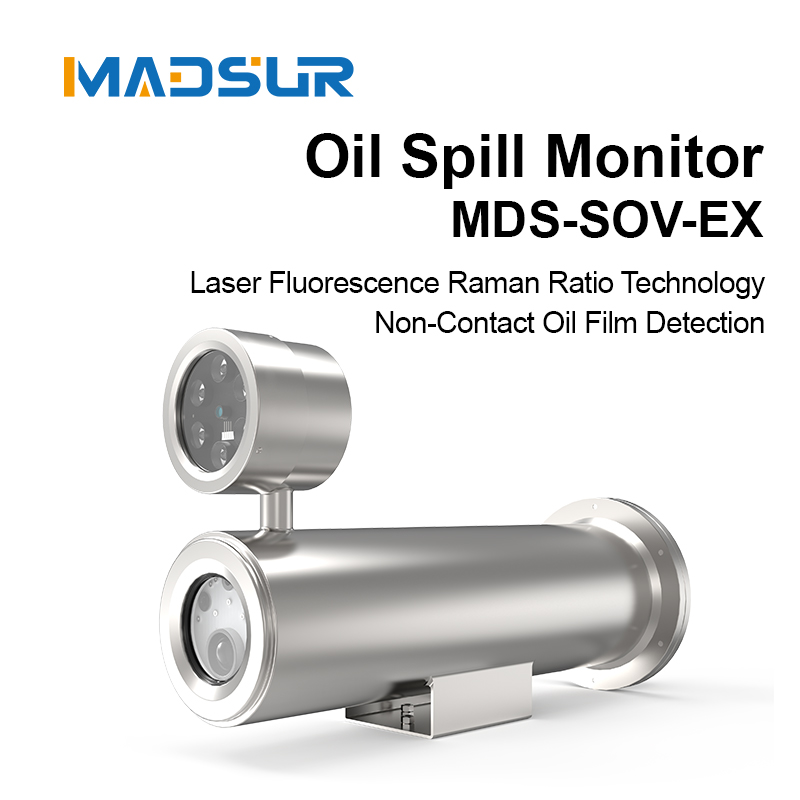
MDS-SOV-EX Oil Spill Detector
Product Introduction
Laser spectroscopy technology is an active optical detection technique. When a laser hits the surface of seawater covered with an oil film, it excites fluorescent radiation from the oil substances while simultaneously generating inelastic Raman scattering light from the water. By analyzing the fluorescence spectrum and Raman scattering spectrum information, quantitative measurement of oil film thickness can be achieved. Laser spectroscopy for oil film thickness measurement offers advantages such as non-contact operation, high speed, high accuracy, and target recognition capability, making it one of the most important and effective methods for surface oil spill monitoring.
Currently, the commonly used spectroscopy-based methods for measuring surface oil film thickness include the fluorescence method and the Raman attenuation method. The fluorescence method retrieves oil film thickness by directly detecting the fluorescence intensity of the oil film. However, it is significantly affected by factors such as detection distance, detection angle, and instrument parameters, making it suitable only for fixed-distance oil film thickness measurement.
The Raman attenuation method measures oil film thickness by detecting the Raman scattering intensity of water excited by the laser. When there is no oil film on the water surface, the stimulated Raman scattering of water is at its strongest. As the oil film thickness increases, the water Raman scattering intensity decreases. The oil film thickness is then calculated based on the attenuation of the water Raman scattering signal. However, when the oil film is thick, the Raman scattering signal attenuates severely, limiting this method to only thin oil films. The measurable oil film thickness range is therefore limited, making it ineffective for practical applications.
This system adopts a new method for measuring surface oil film thickness — the laser fluorescence-Raman ratio method. It compares and analyzes the fluorescence intensity generated by laser excitation in areas covered with an oil film against the water Raman signal intensity in areas without an oil film. This approach accurately obtains surface oil film thickness data at varying distances and greatly expands the measurable oil film thickness range.
Features
1. Adopts the laser fluorescence-Raman ratio method, achieving accurate measurement of surface oil film thickness at different distances through comparative calculation of fluorescence and Raman signals.
2. Provides non-contact monitoring capability, operating stably within a range of 1 to 30 meters, effectively ensuring safety during installation and maintenance.
3. Supports 24/7 continuous operation, monitoring surface oil contamination in real time, and triggering automatic software alarms upon detecting anomalies.
4. Features an intelligent judgment mechanism built into the software, comprehensively evaluating multiple data sets to effectively reduce false alarms caused by on-site environmental factors.
5. High enclosure rating for adaptability to harsh environments, with a structural design that facilitates installation and routine maintenance, ensuring long-term stable operation.
Technical parameters
| Measuring Distance | 1-30 m |
| Laser | Pulsed UV Semiconductor |
| Oil Stain Alarm Function | Available |
| Alarm Method | On-site Monitoring Software Prompt |
| Oil Film Thickness | >1μm |
| Thickness Measurement Accuracy | <10% |
| Measurement Time | 2 s |
| Wireless Data Transmission | 4G/485 |
| Data Interface | USB |
| Instrument Power Supply | DC12V; On-site 220V AC power supply required |
| Power Supply Power | 30W |
| Operating Time | 7*24h |
| Operating Temperature | −15°C–50°C |

 WhatsApp