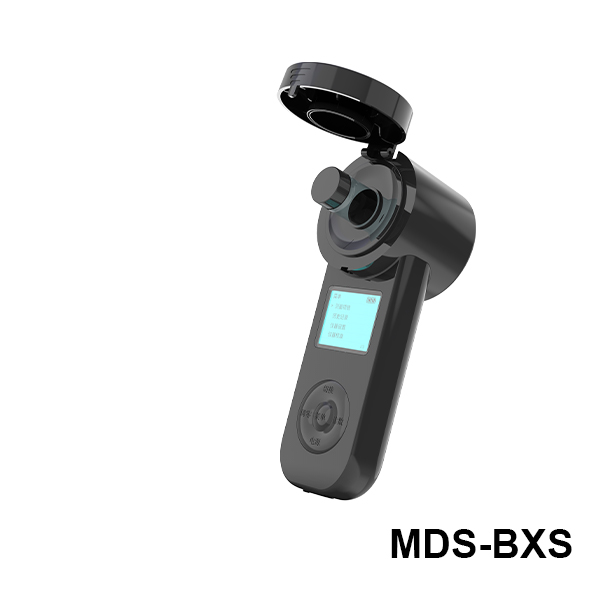
MDS-BXS Series Portable water quality tester
MDS-BXS Series Portable Water Quality Analyzer – Comprehensive Photometric Testing for Drinking Water
-Product Overview-
The MDS-BXS Series Portable Water Quality Analyzer is a next-generation handheld photometric instrument engineered for comprehensive drinking water quality testing. Independently developed and manufactured, this portable analyzer covers all photometric testing items specified in China's 106-item drinking water quality standards (97 items in the new national standard)—making it one of the most versatile portable photometers available for water quality professionals.
The global portable water quality analyzer market is projected to grow from US$932 million in 2024 to US$1,288 million by 2031, driven by increasing demand for on-the-spot water quality assessment and real-time monitoring capabilities. The MDS-BXS Series meets this demand with an embedded modular design, built-in high-capacity battery, and Type-C charging and data transmission interface, delivering fast, stable, and reliable results in any field environment.
A proprietary interference compensation algorithm effectively eliminates measurement deviations caused by light decay, ensuring accuracy even under challenging field conditions. The device supports expanded 4G/5G, Wi-Fi, and Bluetooth data upload capabilities, and when paired with data management software, enables comprehensive water quality data monitoring and full traceability.
-Key Features & Benefits-
Comprehensive Testing Coverage
Covers all photometric testing items in the 106-item drinking water national standards (97 items in the new standard), meeting diverse water quality monitoring needs for drinking water, surface water, wastewater, and industrial process applications.
Modular & Flexible Design
Adopts an embedded modular architecture that supports electrode expansion, allowing users to select different functional modules as needed. This future-proof design adapts to evolving testing requirements without replacing the entire instrument.
High Protection, Portability & Durability
Rated IP67 waterproof with a compact footprint of just 190×73×73mm, this analyzer is purpose-built for field and on-site use. Rugged enough for harsh environments yet light enough for daily carry.
Intelligent Data Interconnection
Supports 4G/5G, Wi-Fi, and Bluetooth data transmission, enabling seamless connection to cloud platforms for remote monitoring, data logging, and compliance traceability. A major trend in the portable water quality photometer market is the integration of Bluetooth and cloud connectivity, enabling real-time data transfer and enhanced compliance reporting.
Simple & Quick Operation
Built-in pre-prepared calibration curves and reagents, combined with a color LCD screen and Type-C interface, make the testing process efficient and intuitive—minimizing training time and reducing operator error.
-Technical Specifications-
| Parameter | Specification |
| Indication Error | ≤5% (Suspended Solids, COD, Sulfate ≤10%) |
| Repeatability | ≤1% |
| Data Storage | 100,000 sets |
| Operating Environment | Temperature: 0~50°C; Relative Humidity: 0~95% (Non-condensing) |
| Protection Rating | IP67 |
| Dimensions | 190 × 73 × 73 mm |
| Power Supply | Built-in high-capacity battery, Type-C charging |
| Data Interfaces | Type-C, 4G/5G, Wi-Fi, Bluetooth |
Complete Test Parameter List
The MDS-BXS Series supports an extensive range of photometric testing parameters, organized by measurement category:
-Physical & General Parameters-
| Test Item | Measuring Range | Detection Principle |
| Turbidity | 0-20/200/1000 NTU | 90° Light Scattering & Transmission Integrated Method |
| Suspended Solids | 0-750 mg/L | Infrared Transmission Method |
| Clarity | Grade I-IV / 0-200 NTU | Multi-beam Light Scattering Method |
| Colority | 0-25/50/500 Hazen | Platinum-Cobalt Standard Colorimetry |
| pH | 4.8-6.8 / 6.5-8.5 | Standard Buffer Solution Method |
-Disinfectants & Disinfection Byproducts-
| Test Item | Measuring Range | Detection Principle |
| Available Chlorine | 5-500 mg/L, 1%-15% | Iodometric Spectrophotometry |
| Residual Chlorine | 0.02-2.0 mg/L | DPD Spectrophotometry |
| Chlorine Dioxide | 0-20/200/1000 NTU | DPD Spectrophotometry |
| Total Chlorine | 0.02-2.0 mg/L | DPD Spectrophotometry |
| Chlorite | 0.02-2.0 mg/L | DPD Spectrophotometry |
| Combined Chlorine | 0.02-2.0 mg/L | DPD Spectrophotometry |
| Ozone | 0.01-0.50 mg/L / 0.01-10.00 mg/L | Indigo Colorimetry / DPD Spectrophotometry |
| Chlorate | 0.05-1.00 mg/L | 3,3',5,5'-Tetramethylbenzidine Method |
-Nutrients & Organics-
| Test Item | Measuring Range | Detection Principle |
| Ammonia Nitrogen | 0.02-5 mg/L (multiple ranges) | Salicylic Acid Method / Nessler Reagent Method |
| COD | 3-40 mg/L (UV) / 10-1500 mg/L | Potassium Dichromate Oxidation Method |
| Total Phosphorus | 0.02-30.00 mg/L | Vanadium-molybdenum blue spectrophotometry |
| Phosphate | 0.2-2.00 mg/L | Phosphomolybdenum blue spectrophotometry |
| Total Nitrogen | 0.5-100.0 mg/L | Persulfate Oxidation Method |
| Nitrate Nitrogen | 0.2-3000 mg/L | Colorimetric Method |
| Nitrite Nitrogen | 0.005-0.300 mg/L | Diazotization Coupling Spectrophotometry |
| TOC | 5.0-800.0 mg/L | Potassium Persulfate Oxidation & Indicator Method |
-Metals & Inorganics-
| Test Item | Measuring Range | Detection Principle |
| Hexavalent Chromium & Total Chromium | 0.004-1.500 mg/L | Diphenylcarbazide Spectrophotometry |
| Hardness | 5-400 mg/L (multiple types) | Calcium/Magnesium/Total Hardness Test |
| Sulfate | 2-80 mg/L | Barium Sulfate Turbidimetry |
| Cyanide | 0.002-0.400 mg/L | Pyridine-pyrazoline / Isonicotinic acid-barbituric acid method |
| Ferrous Sulfate | 0.2-10.0 mg/L | Orthophenanthroline Spectrophotometry |
| Sulfide | 0.02-1.00 mg/L | N, N-Diethyl-p-Phenylenediamine Spectrophotometry |
| Fluoride | 0.1-2.0 mg/L | SPADNS Spectrophotometry |
| Aluminum | 0.008-0.250 mg/L | Chrome Azurol S Spectrophotometry |
| Zinc | 0-2 mg/L | Zinc Reagent Colorimetry |
| Silver | 0.02-2.00 mg/L | 3,5-Dibromo-PADAP Spectrophotometry |
| Copper | 0.05-5.00 mg/L | Bicinchoninine Colorimetry |
| Nickel | 0-5 mg/L | Dimethylglyoxime Spectrophotometry |
| Iron | 0.01-3.00 mg/L | Phenanthroline Spectrophotometry |
| Manganese | 0.02-5.00 mg/L | Formaldehyde Spectrophotometry |
| Lead | 0.50-5.00 mg/L | Dithizone Spectrophotometry |
| Arsenic | 0.02-0.20 mg/L | Arsine Generation Colorimetry |
-Applications-
The MDS-BXS Series Portable Water Quality Analyzer is ideally suited for:
Drinking water quality monitoring – Municipal water supply, water treatment plants, distribution networks
Environmental field surveys – Surface water, rivers, lakes, and reservoirs; Wastewater treatment – Process control and effluent compliance testing
Emergency response – Rapid on-site assessment during contamination events
Industrial process water – Quality assurance in manufacturing and food & beverage
Aquaculture – Pond and tank water quality spot checks
Scientific research – Field data collection for environmental studies
Compliance verification – Regulatory audits and reporting
Why Choose the MDS-BXS Series?
Challenge: MDS-BXS Series Solution
Limited parameter coverage: Covers all 106 photometric items—one instrument, complete testing
Field accuracy concerns: Proprietary interference compensation algorithm eliminates light-decay errors
Data management complexity: 4G/5G/Wi-Fi/Bluetooth upload with cloud platform integration
Harsh field conditions: IP67 waterproof, compact 190×73×73mm design
Training & usability barriers: Pre-prepared curves, color LCD, intuitive interface
Future expansion needs: Modular design supports electrode and function module expansion
-Ordering Information-
Type: Portable photometric water quality analyzer
Protection Rating: IP67
Data Storage: 100,000 sets
Connectivity: Type-C, 4G/5G, Wi-Fi, Bluetooth
Power: Built-in high-capacity battery
Calibration: Factory pre-calibrated; user calibration supported
Customization: Parameter modules available upon request
Upgrade your water quality testing capability with a comprehensive, portable photometric analyzer. Contact our team today for technical consultation, custom parameter configurations, or to discuss your specific water quality monitoring requirements.

 WhatsApp