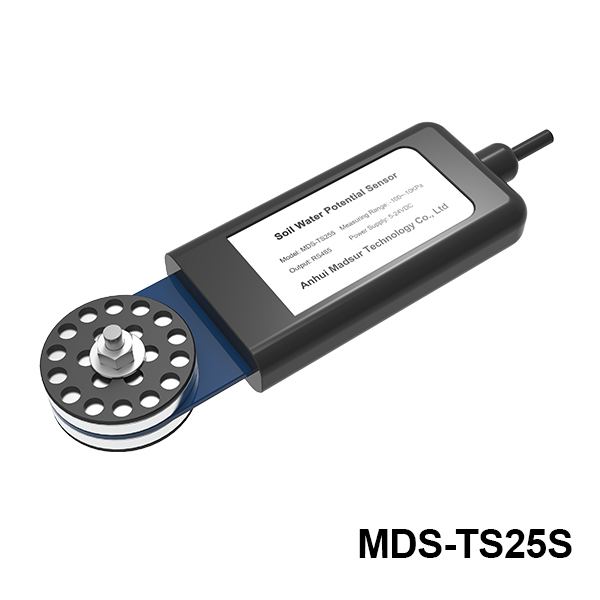
MDS-TS25S Oil Water Potential Sensor
-Overview-
The MDS-TS250S Soil Water Potential Sensor is an intelligent sensing device designed specifically for long-term field monitoring. It can be quickly inserted into a soil profile pit and installed by wrapping it with moist soil. It requires no water filling, is maintenance-free, and needs no on-site calibration, enabling direct measurement of a wide range of soil water potential. It is especially suitable for cavitation-prone environments where tensiometers fail.
The sensor operates on the principle of soil water potential: water potential reflects the degree of soil water saturation, zero when saturated, and negative when dry. The more negative the value, the more severe the drought. The self-calibrating ceramic sensing element eliminates drift caused by material degradation, ensuring accurate and stable measurements. The epoxy overmolding process gives the entire unit an IP68 protection rating, allowing it to operate in a wide temperature range of -40°C to 85°C.
The product is suitable for applications such as agricultural irrigation decision-making, drainage control, and soil research in arid regions. frozen soil monitoring, and roadbed engineering. Users simply need to bury the sensor, set the clock and logging interval, and the device will automatically record data — no programming required. It features integrated RS485 (Modbus-RTU protocol) or 4–20 mA signal output, operates on a 5–24 V DC power supply with low power consumption of just 3–5 mA, making it easy to connect to various data acquisition systems. Its compact, lightweight design (200 g total weight) further reduces on-site deployment difficulty, providing a reliable and hassle-free measurement solution for soil water potential research.
-Features & Benefits-
1. No need for water filling or on-site calibration to directly measure soil water potential; solves the problem of tensiometer failure due to cavitation in dry conditions, especially suitable for long-term unattended field monitoring
2. Self-calibrating ceramic material eliminates measurement drift caused by material degradation; data remains reliable over long-term use without the need for repeated calibration
3. Operating temperature covers extreme cold to extreme heat; the epoxy overmolding process, combined with an IP68 protection rating, allows long-term burial in harsh environments such as wet or frozen soil
4. Simply coat the sensor with slurry, bury it at the desired depth, and backfill with soil; no programming or complex setup required; automatic data collection begins after setting the clock and logging interval
5. Supports RS485 (Modbus-RTU protocol) and 4–20 mA analog output, meeting the access requirements of different data acquisition systems with long transmission distances.
6. Low power consumption design with extremely low operating current, tolerant power supply requirements, suitable for battery-powered field monitoring stations for long-term continuous operation
Technical parameters | |
Operating Temperature | -40~85°C |
Operating Humidity | 0~100%RH |
Storage Temperature | -40~125°C |
Storage Humidity | <80% (non-condensing) |
Sensor Type | Ceramic Material |
Range | -100~10kPa |
Response Time | 200ms |
Accuracy | ±2kPa |
Resolution | 0.1kPa |
Signal Output | RS485 or 4~20mA |
Supply Voltage | 5~24V DC |
Power Consumption | 3~5mA |
Protection Rating | IP68 |

 WhatsApp