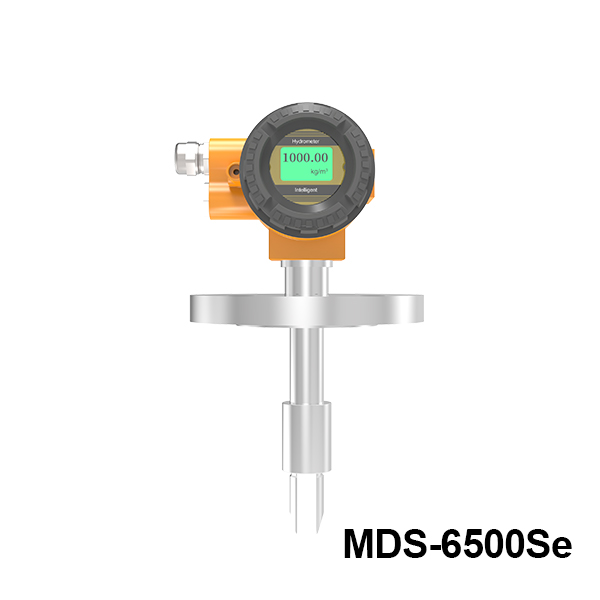
Tuning fork Densitometer/concentration meter
-Overview-
The tuning fork density meter provides accurate online density and concentration measurements based on the tuning fork vibration principle. This convenient, reliable, and high-precision instrument is widely used in the petrochemical, food, and pharmaceutical industries. It also enhances interface detection, concentration control, and mixing operations for process media such as slurries and corrosive liquids (e.g., acids, alkalis).
Working principle: Tuning fork densitometers primarily measure liquid density based on the change in the frequency of a tuning fork's vibration. When a tuning fork vibrates in a liquid, its vibration frequency changes with the liquid's density. This frequency change is related to the liquid's density; by measuring the tuning fork's vibration frequency, the liquid's density can be indirectly determined.
-Features& Benefits-
1. Employs a 4-wire transmitter with 4-20mA output;
2. Real-time display of six-digit density values(five decimal places), with real-time indication of concentration and temperature;
3. Allows direct on-site access to the instrument menu for parameter setting and debugging, ensuring convenient operation;
4. Features pure water calibration, measurement value fine-tuning, and temperature compensation functions;
5. Online real-time measurement, directly applicable to production process control;
6. Liquid-contact parts are made of 316 stainless steel, zirconium, etc., ensuring safety, hygiene, and excellent corrosion resistance;
-Application Conditions-
Pipelines and Terminals
• Liquid interface stratification improves switching accuracy and product quality and reduces waste, scrap, or degradation in multi-product pipelines
• Leak Detection detects material leaks
Refining, Chemicals, and Petrochemicals
• Product quality and process control: Optimize residence/circulation time while minimizing energy consumption in condensers, contactors, and reactors.
• Mixing and concentration control: Reduce scrap, rework, and leaks through precise measurement of feed and production media quality.
Power Generation and Mining
• Flue Gas Desulfurization: Minimize raw material costs to optimize emissions and increase efficiency
• Slurry: Optimize final product efficiency by determining the composition and characteristics of slurry flotation reagents
Measurement within the reactor
• Real-time measurement of density, concentration, and temperature within the reactor, solving the challenge of high-precision density measurement within reactors
• Real-time monitoring of material density changes without the need for sampling, making it more environmentally friendly and safer.
-Technical parameters-
Item | Specification |
Measuring Range | 0 – 2.5 g/cc (0 – 2500 kg/m³), 0.1~100.0% |
Calibration Range | 650–2000 kg/m³ |
Measurement Accuracy | ±0.002 g/cc (±2 kg/m³), 0.1% |
Repeatability | ±0.0002 g/cc (±0.2 kg/m³) |
Operating Temperature Range | -50°C ~ +150°C (customizable) |
Maximum Working Pressure | 4 MPa (customizable) |
Fluid Viscosity Range | 0 – 600 cP (customizable) |
Temperature Coefficient | Less than 0.1 kg/m³/°C (after calibration) |
Pressure Influence | Negligible |
Built-in Temperature Sensor | Digital sensor (PT100) |
Wetted Material | 316L, 2205 stainless steel, Hastelloy, titanium alloy, etc. |
Fork Coating | PTFE, PFA, etc. |
Power Supply | 24VDC, ≥50 mA |
Analog Signal Output | 4–20 mA, RS485 Modbus RTU |
Process Connection | Flange, thread; IDF and RJT sanitary types |
Protection Class | IP66 |
Housing | Aluminum Alloy |

 WhatsApp