Digital Chloride Ion Sensor Applications and Value in Online Water Quality Monitoring
I. Integration and Communication Value Brought by Digital Architecture
Sensors include built-in signal conditioning and computing units that output standardized digital signals, offering greater resistance to line interference and ensuring signal integrity during long-distance transmission without attenuation or distortion. Using universal communication protocols, they can be directly connected to multi-parameter monitoring terminals and automatic control platforms, simplifying the need for additional transmitter modules and facilitating multi-site networking and synchronized multi-parameter acquisition. The sensor body can store calibration parameters and records, supporting off-line calibration before deployment and reducing on-site commissioning complexity, making it well-suited for distributed and remote water quality monitoring systems.
II. Corrosion Risk Management Value in Industrial Water Systems
In circulating cooling water and process water systems, chloride ions are a key factor inducing metal pitting and stress corrosion. Sensors continuously track chloride enrichment trends and provide feedback on concentration ratio changes, offering a basis for blowdown and make-up water regulation to prevent sustained chloride accumulation from causing corrosion damage to heat exchange equipment and piping. Real-time data enables dynamic adjustment of operational strategies, balancing water conservation objectives with corrosion prevention requirements, reducing equipment maintenance and replacement costs, and ensuring safe and stable process system operation.
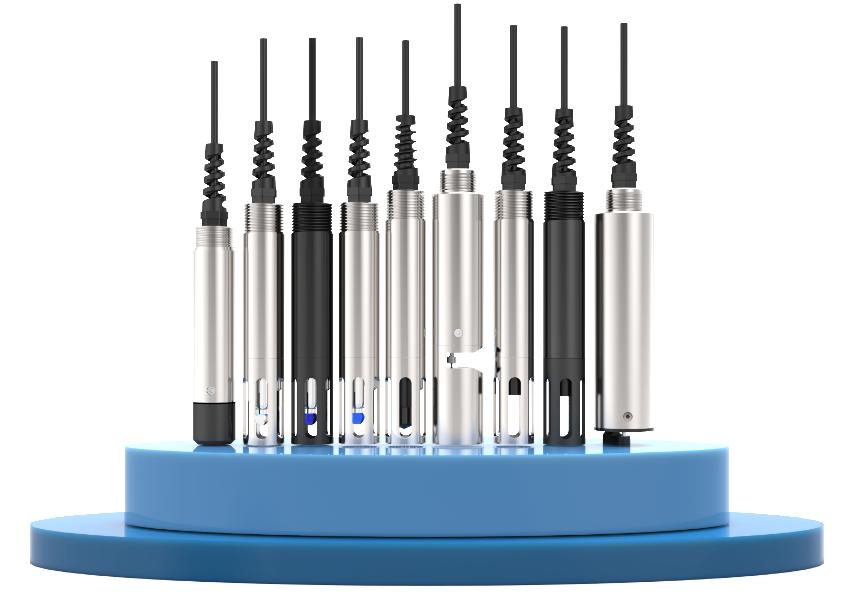
III. Water Environment and Drinking Water Quality Management Value
In surface water, groundwater, and municipal water supply network monitoring, chloride can serve as a characteristic water quality indicator for identifying external pollution, water salinization, and cross-leakage risks in pipeline networks. Continuous monitoring captures short-term concentration fluctuations, enabling timely detection of anomalous inputs and supporting pollution source tracing and risk early warning. Simultaneously, continuous tracking of chloride levels in supplied water ensures stable sensory indicators and meets drinking water quality management requirements, filling the temporal blind spots of intermittent sampling.
IV. Practical Value for Operation and Maintenance and Long-Term Monitoring
Sensors integrate temperature compensation mechanisms that automatically correct potential deviations caused by water temperature changes, enhancing detection stability under varying operating conditions. No reagents are required, eliminating reagent consumption and waste liquid generation, and reducing maintenance workload. The integrated structure supports long-term submerged installation and can be paired with cleaning components to mitigate fouling accumulation, making it suitable for long-term operation at unattended sites such as field locations and discharge outlets. Periodic calibration verification is sufficient to maintain detection performance, making it suitable for routine, uninterrupted water quality tracking.
V. Monitoring Boundaries and Quality Control Support Value
These sensors are in-situ screening monitoring devices with certain ion selectivity limitations. High concentrations of coexisting interfering components and high-turbidity, high-color water samples can affect detection accuracy, and they cannot directly replace laboratory standard methods. Their value lies in continuous process monitoring, with data used for trend assessment and early warning; anomalous sites can be simultaneously sampled and sent to the laboratory for verification. By combining online screening with laboratory comparison, a tiered monitoring model is established to improve water quality management response efficiency.
Digital chloride ion sensors, characterized by digital transmission, in-situ continuous detection, and low maintenance load, address multiple needs including industrial corrosion control, water environment risk early warning, and drinking water quality monitoring. By properly understanding their applicable boundaries and implementing regular calibration.https://www.madsurgroup.com/products/water-quality-sensor/
Previous: It's already the first one
Next: Application of Online Refractometers in the Food and Beverage Industry

 WhatsApp